
How Do You Identify Early Adopters?

Why your first customers are often the people already trying to solve the problem you address.
Early adopters are easiest to identify by the problems they are already trying to solve. Look for people who have created workarounds, searched for alternatives, or spent money on inadequate solutions. Then invite them to make a concrete commitment, such as testing a prototype or joining a pilot.
Before a product launches, these behaviors identify promising candidates. After launch, actual adoption reveals whether you found them.
Early Adopters Are Not Simply People Who Love New Technology
In 1962, sociologist Everett Rogers introduced his Diffusion of Innovations framework, explaining how new ideas and technologies spread through populations.
Rogers divided adopters into five categories:
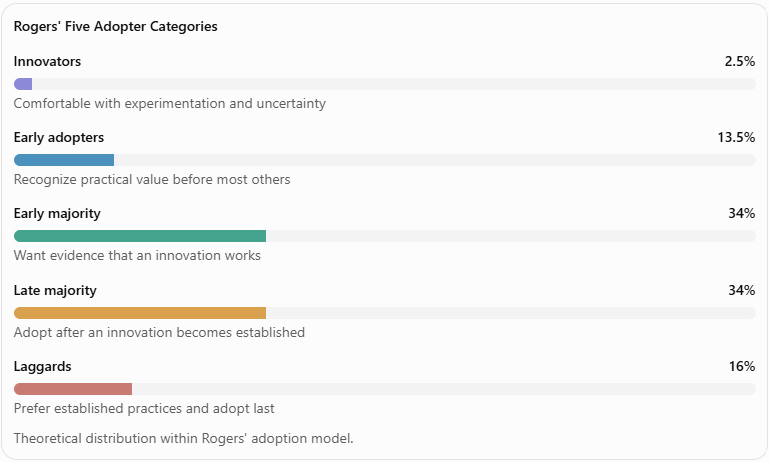
The distinction between innovators and early adopters matters. Someone who downloads every new AI application might enjoy experimentation without having a particular problem to solve. An executive who rarely experiments with technology might adopt an unfamiliar AI tool immediately if it eliminates an expensive operational bottleneck.
Early adoption describes someone's relationship to a particular innovation, not simply their personality.
Look for People Already Solving the Problem
Entrepreneur Steve Blank developed a useful description of initial customers, whom he calls earlyvangelists, combining early adopters with advocates.
In his essay Perfection by Subtraction, Blank identifies five characteristics. These customers have a problem, recognize it, are actively seeking a solution, have assembled an interim workaround, and possess or can obtain a budget to purchase something better.
The workaround is especially revealing.
Imagine a company developing software to improve employee onboarding. Its founders interview two human resources managers.
The first says the concept sounds valuable and asks to receive updates when the product launches.
The second has built a complicated spreadsheet, coordinates onboarding through several applications, and spends three hours every Friday fixing missed tasks.
Both express interest. But the second has demonstrated a problem significant enough to change how they work.
That person is the stronger early-adopter candidate because the problem already consumes resources. The next challenge is determining whether the proposed software improves on the workaround enough to justify switching.
Find Them Where the Problem Is Visible
The search should begin with a specific problem and the people experiencing it most intensely.
Professional communities, specialist forums, industry events, product reviews, and conversations among practitioners provide useful starting points. Pay attention to people explaining what they have tried, why existing products failed, and what those failures cost them.
Instead of asking a broad audience whether it wants a new product, find people already discussing the work that product is supposed to improve.
Paul Graham illustrates this approach in his 2013 essay Do Things That Don't Scale.
Graham describes how Stripe's founders personally recruited developers and helped them implement the payment-processing platform immediately. When someone expressed interest, the founders sought to get the product running rather than simply promising access to a future beta.
This reduced the distance between interest and adoption while exposing obstacles customers encountered during implementation.
The lesson extends beyond software. Early customer discovery often requires direct conversations, individual demonstrations, and hands-on assistance before broader marketing becomes efficient.
A narrow audience with a shared, urgent problem provides a stronger starting point than a large audience with scattered interests.
Ask About Actions, Not Intentions
Customer interviews help identify potential early adopters, but hypothetical questions produce weak evidence.
"Would you use a product that solves this problem?" invites speculation and politeness.
"When did you last encounter this problem, and what did you do?" asks for evidence.
Rob Fitzpatrick develops this distinction in The Mom Test, a guide to conducting customer conversations without confusing compliments with useful feedback.
A productive interview explores the last occurrence of the problem, alternatives someone has tried, resources already spent, and consequences of leaving it unresolved.
The next step is requesting a concrete commitment: testing a prototype, sharing relevant data, arranging a pilot, or making a purchase.
That commitment should match the product's maturity. Someone refusing to purchase unfinished software is not automatically an unsuitable customer.
In Business Markets, the User and Buyer May Be Different People
An important complication arises when selling to organizations.
The person experiencing the problem might not control the budget. An enthusiastic employee could become a daily user while a department head, procurement team, or executive determines whether the company can purchase the product.
Consider the onboarding example. The HR manager wants the software, the HR director controls spending, and the IT department must approve integration.
Identifying the early adopter therefore requires understanding the people involved in adoption, not merely finding the most enthusiastic individual.
A promising internal champion understands the problem, introduces decision-makers, and helps establish a business case. Without a path to purchasing approval, interest rarely becomes revenue.
The Strongest Evidence Comes After the First Yes
Before a product exists, existing behavior helps identify candidates. Once a usable solution becomes available, adoption behavior becomes the stronger test.

Each stage provides different information. Interest indicates curiosity. Commitment demonstrates willingness to invest resources. Trial shows someone attempting to solve a real problem with the product.
Continued use provides evidence of lasting utility. Advocacy suggests that someone values the product enough to recommend it.
The appropriate measure depends on the product. A tax preparation application should not be judged by daily engagement, and enterprise purchasing decisions often take months.
Early adopters also tolerate incomplete features and unfamiliar interfaces that mainstream customers reject. Their adoption establishes an initial market, not proof of mass-market appeal.
The next challenge is understanding which benefits will persuade more cautious customers without losing what attracted the first users.
What Your First Customers Reveal
Finding early adopters means recognizing unmet demand before it becomes an established market.
Start with people already confronting the problem. Examine their existing behavior, understand what it costs them, and offer an opportunity to demonstrate commitment. Then observe what happens when a solution becomes available.
The next time someone praises an idea, pay attention to what happens afterward.
A compliment tells you what someone thinks. A commitment reveals what they are prepared to do.
📚Bookmarked for You
The Mom Test by Rob Fitzpatrick: How to interview potential customers without confusing encouragement with evidence of demand.
The Startup Owner's Manual by Steve Blank and Bob Dorf: A practical framework for customer discovery, validating assumptions, and developing a repeatable business model.
🧬 QuestionStrings to Practice
The Early Adopter Discovery String
Use this sequence to turn a broad customer hypothesis into a specific test.
"Who experiences this problem most intensely?" → "What are they doing to solve it today?" → "What does their current approach cost them?" → "What commitment would demonstrate that they want an alternative?" → "What small experiment would let us observe that commitment?"
Each answer narrows the search from a potential market to people whose behavior can be tested.
Explore a new question every day with QuestionClass's Question-a-Day.
You just thought more carefully than most people do all day.
One question like this, every morning. Free.
Start My Daily Practice →No password needed · Takes 30 seconds
Discover more from QuestionClass
Subscribe to get the latest posts sent to your email.